Wednesday, May 11, 2011

Turtle Foundation supports new turtle project in Boavista

We are proud to announce that in 2011 season, Turtle Foundation will support a community project aimed at the protection of the turtles nesting in the 3 Km long Varandinha beach, in south Boa Vista.

In late 2009, our team visited the beach of Varandinha, one of the prettiest in the island, to find more than 60 carcasses of slaughtered turtles (see prevous post on our website: http://www.turtle-foundation.org/NewsWeblog/tabid/70/EntryID/153/Default.aspx); it was obvious that this beach needed urgent protection. The community based project started in 2010 with the financial support of GEF – Small Grants Program, however funding didn’t come through for 2011, meaning the beach would be left unprotected. When we heard these bad news, we immediately decided to fund the protection program there.

This initiative is unique in the island, in that protection is ensured by a group of 14 people from Povoação Velha, several of them were former poachers. The leader of this group, Eng. Henrique Cruz, is a well respected person in the island, and president of the Fishermen’s Association of Boavista. About this partnership he said “we are thrilled about this support, and happy that we can continue this important work, to prevent the sea turtles to be slaughtered in this beach and ensure that the turtles are saved for future generations”. He highlighted that future goals of this initiative will include development of ecotourism initiatives, and the creation of an environmental information centre.

Our team is very excited about this collaboration, and wishes this group a very successful season!

Tuesday, May 10, 2011

More turtle art, more from our volunteers!


Besides being volunteer in the Turtle Foundation Projects, Sam Francis is also the director and designer of Dirty Graffix, a company specialized in clothing design. He created a t-shirt "inspired by the 1 in only 1000 baby turtles that make it to adulthood". Check it out: http://www.dirtygraffix.co.uk/product/go-tee


Friday, May 6, 2011

Sam Francis' blog about his volunteer experiences

Sam was a volunteer with Turtle Foundation last September (during the rainy season!).  He's written a blog about his experiences - it's wonderful!  Here are some excerpts:

"My day to day life goes like this- wake up breakfast coffee swim read walk eat swim games sleep, then it gets to the evening and eat patrol poachers tag turtle help turtle monitor turtle chill sleep. I love it." 

"Almost every one I have met here has been really honest, genuine and friendly. Its refreshing and an amazing lesson in life being here. Every one is from a different background, a different country, working in different roles and yet we work so well together. . . Being here is not just beneficial for the turtles, its also about living and working together with people who until now had not existed in your life. It really is a great lesson and experience."

"It was an amazing feeling, my first releases. The feelings of satisfaction, triumphant hope, and the journey ahead all mixed together. The finish line had been reached for these hatchlings; the ultimate reason beyond the poachers, tagging the mothers and collecting the research came at this point. The final part of the reason I was there, the moment I had been waiting for was bliss."

check it out:
http://samfrancisview.blogspot.com/


More turtle art


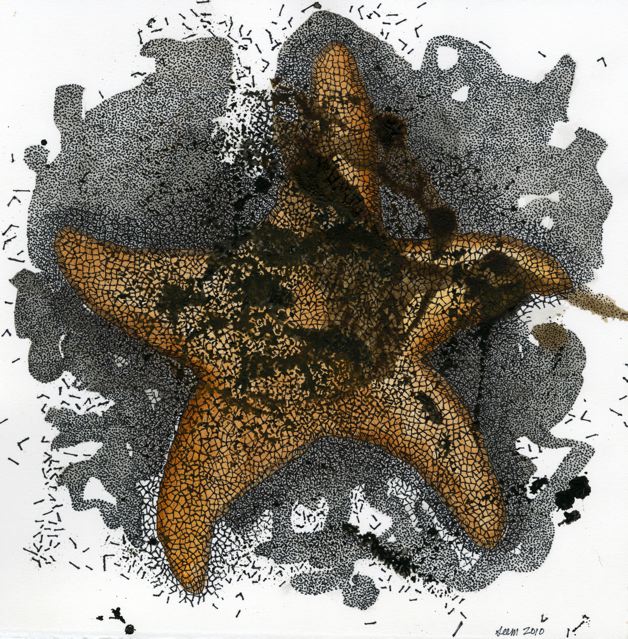
My grandmother, an artist, has been doing some work inspired by the oil spill.  Her name is Olga Seem, and here are two of her latest works, called "Crude Attack."  Other recent work, ocean related, can be seen at http://www.davisandcline.com/Artist-Detail.cfm?ArtistsID=285&CFID=26103647&CFTOKEN=31226443.

Study looks at risk of pollution for Loggerhead Sea Turtles

Migrating Sea Turtles Pick Up More Pollution

One of the many threats loggerhead sea turtles face is man-made pollution, but the extent of the risk is a question. To begin to look for the answer scientists have measured contaminants in the blood of a group of adult male turtles and tracked their migration along the Atlantic Coast.

The group, led by Jared M. Ragland, a graduate student at the College of Charleston, in Charleston, S.C., captured 19 loggerheads near Cape Canaveral, Fla., in 2006 and 2007. Group members measured and weighed the turtles, took blood samples, and examined their reproductive systems with testicular biopsies. Then they fitted them with satellite transmitters and released them. Over two months, 10 of the animals traveled north as far as Cape May, N.J., while nine remained near Cape Canaveral.

The study, published in the journal Environmental Toxicology and Chemistry, found that the animals had measurable blood levels of 67 different chemicals used in pesticides and other industrial products. The loggerheads that migrated had higher levels than those that stayed near Florida, confirming prior research that found more pollutants in turtles in northern latitudes.

It is possible that the fish and invertebrates that turtles feed on in northern waters are more polluted, but the scientists point out that turtles that migrate eat more, and therefore consume more pollutants. Migrating turtles were on average larger than the permanent residents.

The animals seemed healthy, researchers said, but what constitutes good health in an adult male loggerhead is not clear. “These were reproductively active animals,” said Jennifer M. Keller, a co-author of the study and a biologist with the National Institute of Standards and Technology. “But the males have higher blood levels of contaminants than the juveniles, and that adds to our concern.”

From:

http://www.nytimes.com/2011/04/26/science/26obturtles.html?_r=2&src=recgLink